
The following graphic was posted on X by @DrDonnieDeBord, as an argument in favor of PSA. The problem is, only 5 and 9 use PSA exclusive language, and the scriptures cited don’t say what 5 and 9 claim. I will examine each of these “reasons to believe in PSA” below and show that PSA has been imported into the scriptures every time, instead of drawn from them.
At the outset, I believe it is important to define “justification” (dikaiōsis ) and “justify” (dikaioo) the way the scriptures use them. Justification is not just saying someone who is unrighteous is righteous (a legal fiction), but actually making them righteous by removing the thing that is making them unrighteous…their sin. Think of right justification in a word processor. It aligns the text with the proper line, the right margin. We are brought into alignment with God by having all our sins washed away. That’s the meaning of justification in scripture. PSA has made it transactional rather than relational justification.
Graphic
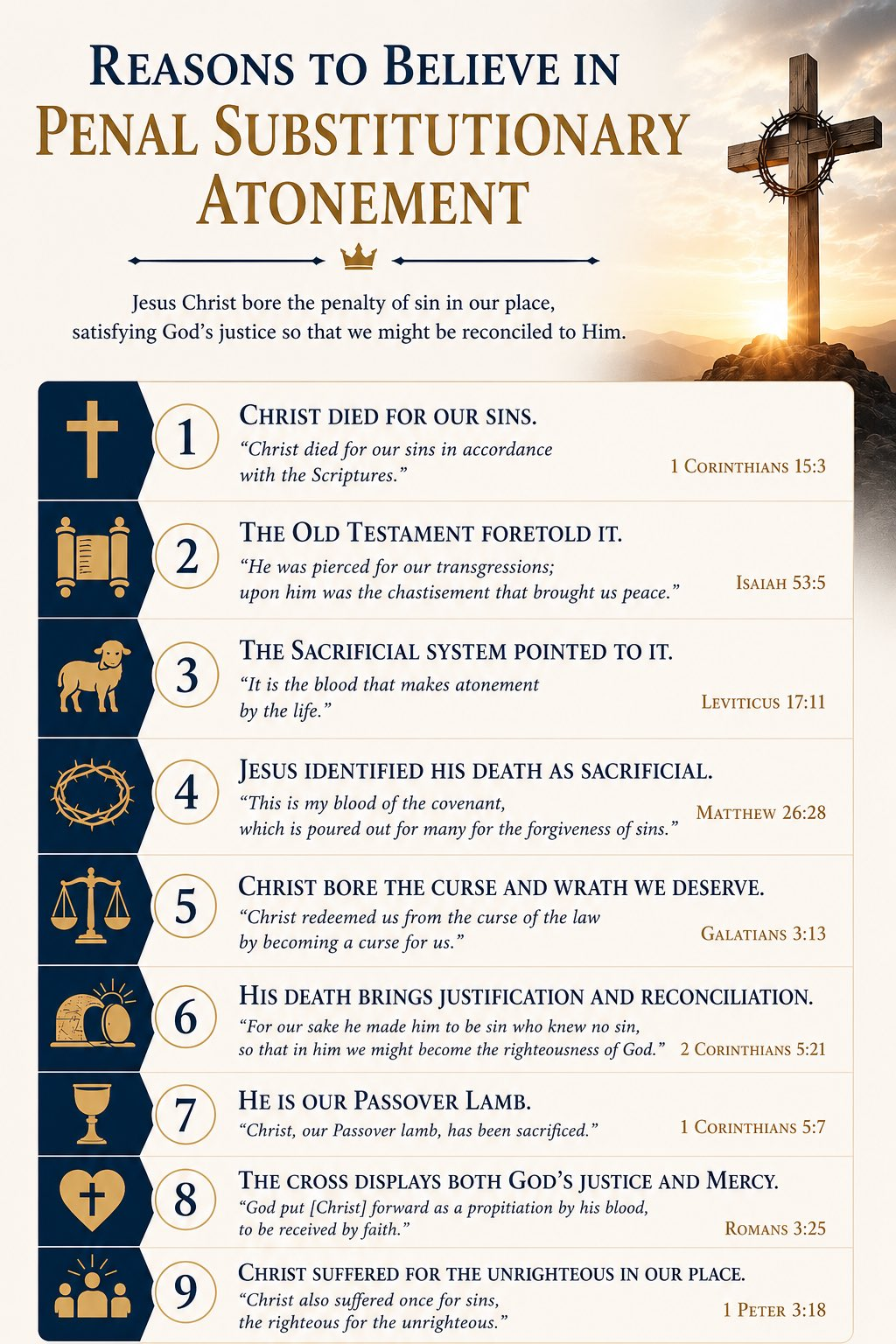
“For I delivered unto you first of all that which I also received, how that Christ died for our sins according to the scriptures”
The (second) word “for” in this verse is hyper in the Greek and it means “on behalf of; for the sake of”. This is true. Christ died on behalf of our sins or for the sake of our sins. His death was needed as an offering of life to God, a pure sacrifice who shed His blood to cleanse us from sin.
An
example of “on behalf of” that shows it does not mean “in
substitution of”. My wife’s mother recently died and her
father has dementia. My wife has power of attorney for (on
behalf of) her father. She is not substituting as her father
such that she incurs any legal penalty or gains any legal benefit
that would be due her father. He is the one that benefits from
her actions. She is merely acting on his behalf because he
cannot act for himself.
What cannot be demonstrated from
this passages it that Christ died as a substitute for us with our
sins imputed to Him so that He was subject to the wrath/punishment of
God. In fact, none of the passages cited in this graphic will
show any part of that: substitution, imputation of sin or
righteousness to another, or punishment of Christ by the Father.
2. The Old Testament Foretold It (Isaiah 53:5)
“But he was wounded for our transgressions, he was bruised for our iniquities: the chastisement of our peace was upon him; and with his stripes we are healed.”
“It” being PSA, yet there is nothing in this verse or this passage that teaches the specific tenets of Penal Substitutionary Atonement.
What the Jews thought was righteous judgment by God against a false Messiah was in reality Jesus going willingly to the cross to be wounded by those He had come to save, enduring the suffering of the cross for them. In doing so, He showed the ultimate turn the other cheek. "Father, forgive them, for they know not what they do." Even in dying Jesus sought to forgive, sought to draw men unto Himself, and in death shed His blood which cleanses us from our sins.
It wasn't the Father that put Christ on the cross, though that plan was willingly accomplished by the Godhead in perfect unity foreseeing what man would do and determining to use that for the good of all mankind. It was the sins of humanity that put Him there. The Hebrew preposition מִ (mem) means "from". It is translated as "for" in the KJV using a more archaic application of the word "for" that is now confusing to us. All modern translations have kept the word, but the meaning is then lost to modern readers. He was wounded "from" our transgressions/bruised "from" our iniquities are the more accurate phrases. Had man not sinned against God, there would have been no need for this at all. Yet this was not God's wrath being demonstrated.
It was His love for mankind being demonstrated.
I have thought long about this phrase "the chastisement of our peace was upon Him". I have come to a different conclusion that I have not heard anyone else say before, though I admit I have not read as much material from Christianity as I would like. Chastisement is correction. What is receiving correction here? Certainly not the Servant, Jesus. He had no sin, had nothing to be corrected for. I believe that it is the understanding the Jews had, that men had, about peace. Throughout the Old Testament we read about how the Jews incorrectly viewed peace. They sought a peace through conquering all their enemies and ruling the world through might of arms such as in the days of David and Solomon. Jeremiah spoke of this where they thought they would have peace, but there was no peace to be had (Jer 6:14; 8:11), but Jesus spoke of peace differently. In physical terms, He said He had not come to bring peace, but a sword (Matthew 10:34; Luke 12:51). Yet what did He say to the Apostles as He was preparing them for His death and departure from the world?
"Peace I leave with you, my peace I give unto you: not as the world giveth, give I unto you. Let not your heart be troubled, neither let it be afraid." (John 14:27).
He taught them that He was giving peace to them but not as the world gives peace. He was correcting their idea of how peace was to be found, not through might, through strength of arms and conquering enemies with the sword, but by trusting in Him, by resting in the truth of the gospel and the eternal life He was bringing to them through His death.
The chastisement/correction of their understanding of peace was upon Him means that in His death, He was restoring to them eternal life and ending enmity between God and man, between Jew and Gentile, and bringing together all men in Him.
In being human and coming in the flesh living as we lived, enduring all that we endured including real temptation, He was able to heal us. He endured the sins of mankind who tortured Him, mankind who crucified Him, that we could be made dead to sin and alive unto righteousness as Peter wrote in 1 Peter 2:24. Our sins put Him on the cross and by those stripes that we inflicted on Him we are healed, we are restored to our relationship with Jehovah.
“For the life of the flesh is in the blood: and I have given it to you upon the altar to make an atonement for your souls: for it is the blood that maketh an atonement for the soul.”
“It” being PSA. Nothing in this demands the idea of punishment or substitution. This is not a death offering as PSA teaches. It is an offering of life. The sacrificial system had the animal killed before the altar, not on it. The blood, which had the life as the verse says, was a pure offering given as a sweet savor unto God, not a vicarious punishment of the animal (a thought not taught until Charles Hodge in the 1800s).
Atonement (kaphar/kippur) is a covering over, not a punishment. Think of the complete covering over of baptidzo to change the nature of the things baptized, like a dye. When we are completely covered over in the blood of Christ, we are changed, made right with God. So the atonement here is an antitype of that covering over. It is not the idea of punishment where an angry God is moved to satisfaction and love to be reconciled to us. God already loved us before Christ was sent. It is why He sent His Son in the first place (Romans 5:8). Atonement is the idea of us being cleansed and moved toward God.
“For this is my blood of the new testament, which is shed for many for the remission of sins.”
Indeed,
His death was sacrificial. His blood was shed on behalf of
(peri) many unto (eis) the remission of sins.
But
sacrificial doesn’t mean punishment. It’s not about
substitution, about Christ taking our place, but Christ dying for us
as a pure offering of life to God so that His blood could purify us
in baptism, not so that our sins could be imputed to Christ and His
righteousness could be imputed to us in some kind of weird legal
fiction where God is pretending.
“Christ hath redeemed us from the curse of the law, being made a curse for us: for it is written, Cursed is every one that hangeth on a tree:”
Put simply, there is no mention of “wrath” in the context of Galatians 3 and certainly not “wrath we deserve” much less that Christ was subject to God’s wrath.
The curse of the law was that you had to continue in all things that were contained within the law. It was this curse the Christ redeemed the Jews, who were under the law of Moses, from by being made a (different) curse, that is, being hung on a tree as the law says in Deuteronomy 21:22–23. Paul is not saying Jesus became the curse of the law. It is a play on words. To redeem the Jews from THE curse (definite article), Jesus was made A curse (no definite article).
But this has to do with the Jews specifically. The context of Galatians was Paul arguing that the Galatians did not have to follow the law of Moses at all as they were Gentiles. Why would they give in to Judaizing influencers, to the fleshly shadows and types of the Old Covenant they were never under, when they had the spiritual antitypes of the New Covenant that could really save them?
“For he hath made him to be sin for us, who knew no sin; that we might be made the righteousness of God in him”
This is about God’s incarnation, not His crucifixion. Being made sin for us here is equivalent to what Paul wrote in Romans 8:3 - “For what the law could not do, in that it was weak through the flesh, God sending his own Son in the likeness of sinful flesh, and for sin, condemned sin in the flesh:” Jesus condemned sin in the flesh by living a perfect, sinless life as one of us. And then, by giving up that life and shedding His blood, He is able to wash us clean in His pure blood - not His filthy, vile blood stained with all the sins ever committed by man - to make us ontologically righteous before God in Him.
This isn’t a declaration of Christ’s guilt and our innocence when the reality is Christ is innocent and we are guilty. That’s legal fiction. Pretending. An abomination before God (Proverbs 17:15). This isn’t God damning Jesus to Gehenna in our stead as R.C. Sproul, noted Calvinist put it so bluntly.
“Purge out therefore the old leaven, that ye may be a new lump, as ye are unleavened. For even Christ our passover is sacrificed for us:”
Christ
is indeed our passover who was sacrificed for (hyper) us - on our
behalf. This is not PSA. PSA is being imported into this
verse, but the passover lamb in Exodus was not punished for the
families in Egypt. It was a life given to be “covered” by
the blood (on the door post), and a meal eaten to prepare them for
becoming God’s covenant people, typifying the Lord’s Supper that
we partake of today.
PSA is about punishment and death.
Passover is about life, rescue, and covenant.
“Whom God hath set forth to be a propitiation through faith in his blood, to declare his righteousness for the remission of sins that are past, through the forbearance of God;”
Usually the PSA proponents will focus on that word “propitiation” which is the act of appeasing, pacifying, or regaining the favor of an offended party. This is a pagan concept and not a good translation of the word hilastērion. In fact, it wasn’t until the Reformation (1568) that the word was even translated as propitiation in the English translations due to the influence of men like Calvin and Zwingli, and because of Jerome’s use of the Latin word propitiationem. Before that, the English translation of that word was mercy seat, which is directly from the Greek instead of through the Latin.
The Cross does display both God’s justice and mercy, but not the way that PSA proponents believe. Justice wasn’t being carried out against Christ in the form of punishment. Justification was being carried out on us thanks to Christ. Back up one verse to Romans 3:24 - “Being justified freely by his grace through the redemption that is in Christ Jesus:” and one verse after to Romans 3:26 - “To declare, I say, at this time his righteousness: that he might be just, and the justifier of him which believeth in Jesus.” God had mercy on us and justified us through the blood of Christ cleansing us, making us justified, and restoring us to relationship with Himself. Not by punishing Jesus in some pretense that Jesus was somehow guilty of our sin.
“For Christ also hath once suffered for sins, the just for the unjust, that he might bring us to God, being put to death in the flesh, but quickened by the Spirit:”
Again, PSA is being imported into the text through the English word “for” which is being used to mean “in place of” by PSA proponents. However, in 1 Peter 3:18, the word is again hyper, which means “on behalf of” and does not carry with it the idea of substitution. Note what the rest of the verse says. Christ, the just one, suffered on behalf of the unjust to bring us to God. He died to reconcile us to God, to move us, not God. He died that we might benefit because His pure, sinless blood purifies us and makes us holy, not because our sins are imputed to Him as PSA contends.
The crucifixion of Christ is not something Christ did as a substitution of us, but as a representative of us. We participate in that crucifixion (Galatians 2:20 - I am crucified with Christ…) when we are baptized (Romans 6:3-5).
None of the verses posted teach Penal (punishment of Christ) Substitutionary (Christ died instead of us) Atonement (appeasement of God’s Wrath). In every verse, PSA has to be imported, which means the entire graphic is a very long begging of the question. PSA itself is not taught anywhere in scripture. No punishment of Christ, no substitution of Christ, and no appeasement of the Father’s Wrath by meting out that punishment against Christ. God is not some wrathful entity just barely being restrained from smiting us for every little infraction by His innocent Son stepping in between and taking the beating for us.
God
is love. He loved us while we were yet sinners. He does
everything to reconcile us to Himself because of that love.
Jesus gave His life
not
His death to God cleanse us, to restore the image of God in us and
destroy the power of the Devil over us (Hebrews 2:14-15).
The burden of proof is on Dr. DeBord to show how any of these passages teach Penal Substitutionary Atonement without importing it first.
In Truth and Love