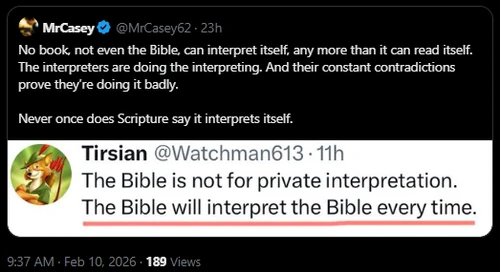
The image on the left was taken from a Catholic account on X. It is typical of the Catholic, Orthodox, and other faiths who hold to Apostolic Succession to claim that we need their clergy, their historical descent from the Apostles and holy tradition to properly interpret the Bible. It is our continual pushback that the Bible interprets itself. In this article, I will examine the claim the high church denominations make and show why it is an invalid claim.
The claim is wrong because it confuses the physical act of reading with the logical process of interpretation. Of course a book cannot physically read or speak, but that is not what is meant when people say that Scripture interprets itself. The principle of self-interpretation means that the meaning of a passage can be clarified, limited, or explained by other passages within the same text. This is not mystical or circular; it is how coherent writing works. Any unified work provides its own definitions, context, and internal controls that guide the reader toward the author’s intended meaning.
The Bible does this explicitly. In 2 Peter 1:20–21 (KJV), Peter says, “Knowing this first, that no prophecy of the scripture is of any private interpretation.” The point is not that Scripture cannot be understood, but that its meaning does not come from isolated or personal speculation. Instead, its meaning is governed by the message God gave through the prophets and apostles. Scripture itself establishes that its parts must be read in light of the whole, not independently or according to outside authority.
We see practical examples throughout the text. In Acts 17:11, the Bereans evaluated Paul’s teaching by “search[ing] the scriptures daily, whether those things were so.” They did not appeal to a separate interpretive authority; they compared one part of Scripture with another to determine truth. Likewise, when Jesus was tempted, He answered each challenge with “It is written” (Matt. 4:4, 7, 10), allowing Scripture to explain and apply Scripture. Even Jesus rebuked the Sadducees by saying, “Ye do err, not knowing the scriptures” (Matt. 22:29), implying that the correct understanding was available within the Scriptures themselves.
The Bible also frequently explains its own symbols and difficult statements. Daniel’s visions are interpreted later in the same book (Dan. 7:16–27). Revelation identifies many of its own symbols (Rev. 1:20). In John 2:19–21, Jesus speaks of destroying “this temple,” and the text immediately explains, “he spake of the temple of his body.” Luke often pauses to clarify sayings or events for the reader (Luke 8:11; Acts 1:5). These are clear cases of the text providing its own interpretation.
Even ordinary language within Scripture is defined internally. Paul explains justification by faith using Abraham in Romans 4, then James discusses the same example in James 2, showing how the concept must be understood in a balanced way. The meaning of faith, works, grace, law, and salvation emerges from the combined testimony of many passages rather than from any single verse taken alone. This is exactly what is meant by the Bible interpreting itself.
The same principle applies to any coherent book. A novel introduces characters, defines terms, and resolves ambiguities through context and later information. A law code explains general rules and then clarifies them with specific cases. If a document could not be understood from its own content, it would be poorly written. The Bible, as a unified revelation, provides repeated themes, definitions, examples, and corrections that function as its internal interpretive framework.
So the claim fails because it attacks a straw man. No one argues that the Bible physically reads itself; the claim is that its meaning is governed by its own context and teaching rather than by external authorities or isolated personal ideas. The consistent practice of Jesus, the apostles, and the early believers shows this principle in action: they explained Scripture by appealing to Scripture.
Saying a book does not interpret itself denies basic reading comprehension realities.